Showing posts with label gems. Show all posts

Thursday, April 2, 2015

The World's Rarest Gems - part 2

Continuing the list of the world's rarest gems, here are 5 more:

5. Alexandrite

Named for Tsar Alexander II of Russia, this exceedingly rare gemstone was thought to be mined out after the original deposits, found in 1830 in Russia's Ural Mountains, were nearly exhausted.

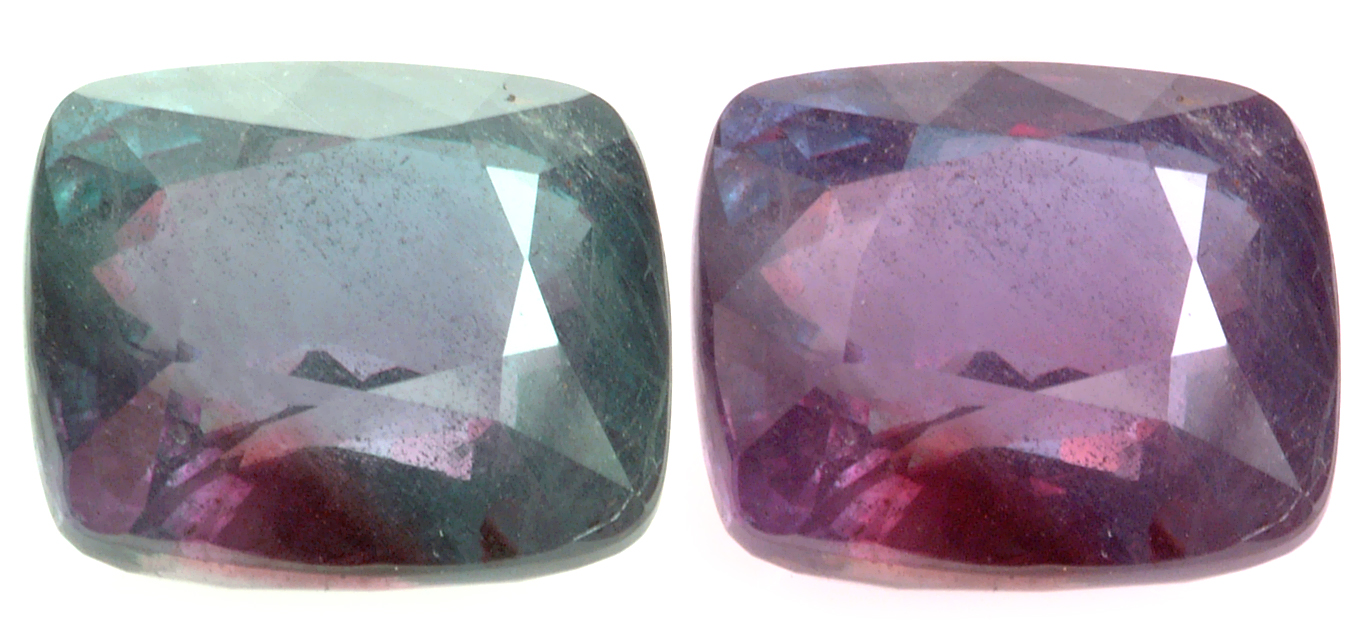
Alexandrite is a color-changing gemstone: its hue shifts from red to green depending on the light it's exposed to. Alexandrite from the Ural Mountains in Russia can be green by daylight and red by incandescent light. Other varieties of alexandrite may be yellowish or pink in daylight and a columbine or raspberry red by incandescent light.
Stones that show a dramatic color change and strong colors (e.g. red-to-green) are rare and sought-after.

Recent finds in Brazil, East Africa and Sri Lanka have brought this stone back on the market, but it is still one of the world's most coveted stones.

Today, several labs can produce synthetic lab-grown stones with the same chemical and physical properties as natural alexandrite. One of these methods produces what is called flux-grown alexandrite, which produces gems that are fairly difficult to distinguish from natural alexandrite as they contain inclusions that can look natural.

Composition: Beryllium, Aluminum, Oxygen | Market Value: $12,000 per carat.

4. Blue Garnet

Although red is the most commonly occurring colour, garnet occurs in almost every colour. One of the most recently discovered colours of garnet is the rare blue garnet, which was discovered in the late 1990s in Madagascar. It has since been found in other regions, such as the USA, Russia, Kenya, Tanzania and Turkey.

It changes color from blue-green in the daylight to purple in incandescent light, as a result of the relatively high amounts of vanadium. The most expensive, a 4.2 carat gem sold in 2003 for $6.8 Million.


3. Musgravite
Another precious stone in the same family as Taaffeite, this stone's color ranges from a brilliant greenish gray to purple. Musgravite was discovered in 1967 in the Musgrave Range of Southern Australia, and for many years there were only eight known specimens.

Recently, small quantities of Musgravite have been located in Greenland, Antarctica, Sri Lanka, Madagascar and Tanzania. Don't let this new "surplus" fool you, though: this incredibly hard stone is still exceedingly rare, fetching $35,000 - or more - per carat.

Composition: Magnesium, Beryllium, Aluminum, Zinc, Iron, Oxygen | Market Value: $35,000 per carat. Its hardness is 8 to 8.5 on the Mohs scale.

2. Red Diamonds
Technically speaking, red diamonds are diamonds, but they serve to highlight the fact that that diamonds actually come in a range of colors. They are, in order of rarity: yellow, brown, colorless, blue, green, black, pink, orange, purple and red. In other words, The clear diamonds you're liable to encounter at your local jeweler aren't even rare as far as diamonds go.

As a point of reference, the largest red diamond on Earth — The Moussaieff Red, pictured here — weighs just 5.11 carats (about 1 gram). The largest traditional diamonds — such as those cut from the 3,106.75-carat Cullinan diamond — weigh in at well over 500 carats. [Photo Credit: The Gemological Institute of America]

1. The Pink Star Diamond
The Pink Star, formerly known as the Steinmetz Pink, is a diamond weighing 59.60 carat (11.92 g), rated in color as Fancy Vivid Pink by the Gemological Institute of America. The Pink Star was mined by De Beers in 1999 in South Africa, and weighed 132.5 carat in the rough. The Pink Star is the largest known diamond having been rated Vivid Pink. As a result of this exceptional rarity, the Steinmetz Group took a cautious 20 months to cut the Pink. It was unveiled in Monaco on 29 May 2003 in a public ceremony.

The Pink Star was displayed (as the Steinmetz Pink) as part of the Smithsonian's "The Splendor of Diamonds" exhibit. In 2013 the Pink Star was auctioned by Sotheby's in Geneva on 13 November 2013. The sale price was USD 83,187,381, a world record for a diamond of any colour and, indeed, for any gemstone.

Tuesday, March 31, 2015

The World's Rarest Gems - part 1

Ever since the dawn of humanity, people have adorned themselves with jewelry and different gemstones. Necklaces, brooches, pendants, or bracelets have all had precious and rare gems.

It takes millions of years for crystals to form in nature, and only a fraction of those will ever be found, mined, cut and sold as gemstones. The value of gemstones depends on many factors, including rarity, quality, setting, and even politics.
Let's take a look at some of the world's most expensive and rarest gemstones.

10. Painite
Painite is a very rare borate mineral. It was first found in Myanmar by British mineralogist and gem dealer Arthur C.D. Pain in the 1950s. When it was confirmed as a new mineral species, the mineral was named after him.
For many years, only three small painite crystals were known to exist. Before 2005 there were fewer than 25 known crystals found, though more material has been unearthed recently in Myanmar.
In 2011 there was a very fine painite on sale for about $1800.00 per carat. Painite is pink to red to brown in color, very strongly pleochroic (showing different hues from different angles) and it fluoresces a lovely green under short wave UV.

9. Jeremeyevite

Pronounced ye-REM-ay-ev-ite, this is a colorless, sky blue or pale yellow stone, the highest quality of which comes from Namibia. In nature it occurs in small obelisk-shaped crystals and has in the past been mistaken for aquamarine. It was named after Russian mineralogist Pavel Jeremejev who discovered the mineral in 1883. As of early 2005, a clean, 2.93-carat faceted gem was selling on the Internet for $2000.00 per carat.


8. Black Opal
The rarest type of Opal, the national gemstone of Australia, Black Opal is also the most valuable gem of its kind. Almost all available Black Opal comes from the Lightning Ridge mine in New South Wales. Australia is the classical Opal country and today is the worldwide most important supplier of Fine Opals. Almost 95 per cent of all Opals come from Australian mines. The remaining five per cent are mined in Mexico, and in Brazil’s north, also in the US states of Idaho and Nevada, but recently the stones have also been found in Ethiopia and in the West African country of Mali.

The brilliant play of color, or "fire," in these dark gems, along with their relative scarcity, causes them to be worth over $2300 per carat.

7. Red Beryl Emerald

Red beryl is found primarily in the Thomas Range and the Wah Wah Mountains of Utah, and has also been reportedly found in a location in Mexico (possibly near San Luis Potosi one of the very few places beryl is also found on rhyolite). Where it is found in Utah it occurs on rhyolite, where it crystallized under low pressure and high temperature, along fractures or cavities and porous areas of volcanic rhyolitic magma. Very few cut specimens exist.
Red Beryl has been described as 1,000 times more valuable than gold: cut stones regularly sell for more than $2,000 per carat - and as much as $10,000 per carat.

6. Taaffeite
Taaffeite (pronounced "tar-fite") is named for Australian gemologist Richard Taaffe, who discovered a cut and polished specimen of the stone in 1945. It is the only gemstone to have been initially identified from a faceted stone. Most pieces of the gem, prior to Taaffe, had been misidentified as spinel. Only a handful of these precious stones have ever been found, making them a true collector's gem.

Found in range of hues ranging from nearly colorless to lavender, mauve and violet, Taaffeite occurs in Sri Lanka and Tanzania. Other sources may be discovered, but until then, Taaffeite remains one of the rarest and most valuable gems in the world.

Composition: Magnesium, Beryllium, Aluminum, Oxygen | Market Value: $1500-$2500 per carat.


To be continued.